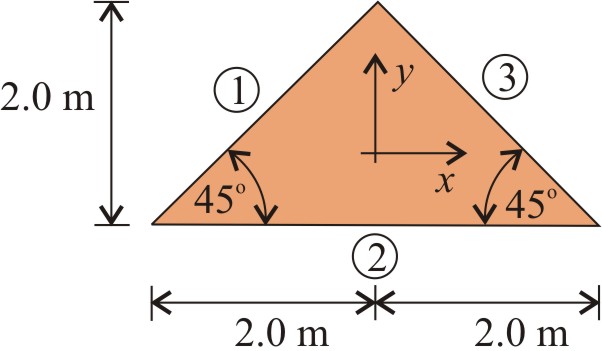
 In the isotropic plate shown in the Figure, a uniform stress field acts:
σx = 60 N/mm2 and σy= −60 N/mm2. The thickness of the plate is t = 20 mm. Show with the use of the equilibrium equations that the plate is not loaded on its surface. Determine and sketch the loads at the edges in the global and in the local coordinate system parallel to the edges. In which special stress-state is the plate?
Solve Problem
Normal force acting on edge 1, N1, [kN/m]= Shear force acting on edge 1, V1, [kN/m]= Normal force acting on edge 2, N2, [kN/m]= Shear force acting on edge 2, V2, [kN/m]= Normal force acting on edge 3, N3, [kN/m]= Shear force acting on edge 2, V3, [kN/m]=Solve
Do you need help?
Steps
Step 1. Write equilibrium equations and prove that the surface of the plate is unloaded. Substitute constant non zero stresses σx = 60 N/mm2 and σy = -60 N/mm2 into the above equations. Since the derivatives of the constant stresses and all the other stresses are also zero, substitution results in Step 2. Give the edge loads in the global x-y coordinate system. Loads must equilibrate the stresses of the element at the edge of the plate. Step 3. Give the edge loads in the local coordinate systems attached to the edges. Results of the stress transformation into the rotated coordinate systems is given below and they are illustrated in the Figure (degrees of the rotations are 45°, 0°,-45°) Since the shear stress is negative, the direction of the load is in the opposite direction, its value is Edge 2 Edge 3 We get the same edge loads if the resultants of fx and fy are calculated at all edges. As it was shown before compression and tension results in pure shear in the 45° direction. Step 4. In which special stress-state is the plate in? The plate is subjected to pure shear.Step by stepCheck proof
Check figure Resultant of the distributes loads are obtained by the multiplication of them with the thickness of the plate.
Check edge loads Edge 1
Check stress-state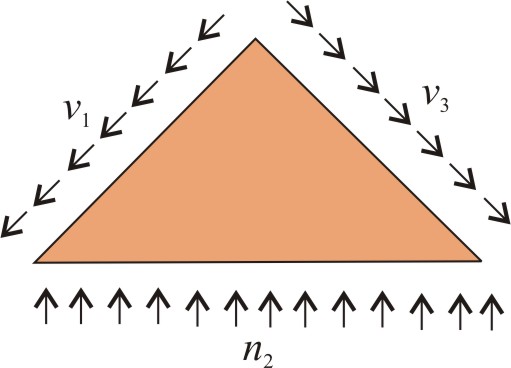
Results
The equilibrium equations are the following We substitute the constant non zero stresses σx = 60 N/mm2 and σy = -60 N/mm2 into the above equations. Since the derivatives of the constant stresses and all the other stresses are also zero, substitution results in these results prove that the surface is unloaded. Loads must equilibrate the stresses of the element at the edge of the plate. The edge loads in the global x-y coordinate system are shown in the Figure below. The edge loads in the local coordinate systems attached to the edges can be obtained by performing stress transformation. Transformations into the rotated coordinate systems are given below and the results are illustrated in the Figure (degrees of the rotations are 45°, 0°,-45°) Since the shear stress is negative, the direction of the load is in the opposite direction, its value is Edge 2 Edge 3 We get the same edge loads if the resultants of fx and fy are calculated at all edges. As it was shown before compression and tension results in pure shear in the 45° direction. The plate is subjected to pure shear.Worked out solution
Resultant of the distributes loads are obtained by the multiplication of them with the thickness of the plate.Edge 1