
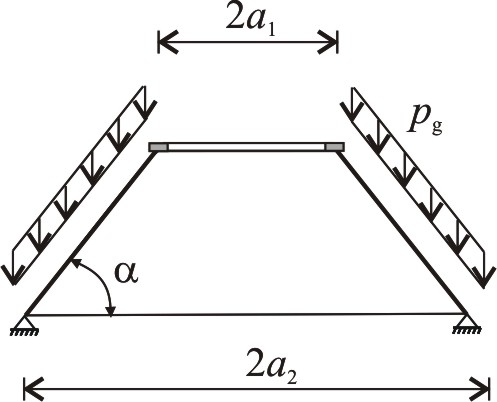
Determine the membrane forces of the truncated cone shown in the Figure from self-weight, pg = 12 kN/m2. The radius of the top edge of the cone is , the radius of the bottom edge of the cone is .
Solve Problem
Meridian force at the bottom, Nα [kN/m]= Hoop force at the bottom, Nφ [kN/m]= Meridian force at the top, Nα [kN/m]= Hoop force at the top, Nφ [kN/m]=Solve
Do you need help?
Steps
Step 1. Determine the meridian force from the vertical equilibrium. Give values at the top and at the bottom of the dome. The free body diagram of an arbitrary parallel cut of the cone is given in the Figure below. The meridian force of the shell of revolution is expressed from the vertical equilibrium. where G is the resultant of the self-weight of the cone part. The surface of the truncated cone is Thus the resultant of the gravity load is Substituting the load resultant into the vertical equilibrium the meridian force becomes Values of the meridian force at the bottom and at the top are Step 2. Determine the hoop force from the equilibrium perpendicular to the surface. Give values at the top and at the bottom of the dome. The meridian of a cone is a straight line, hence one of the principal curvatures is zero, the meridian radius of curvature is infinite, Rα = ∞. Thus, the equilibrium perpendicular to the surface simplifies to the “pressure vessel formula”: The normal component of the gravity load referred to the unit area of tangent plane is The hoop radius of curvature, Rφ is: Thus hoop force becomes Step 3. Draw membrane force diagrams.Step by stepCheck meridian forces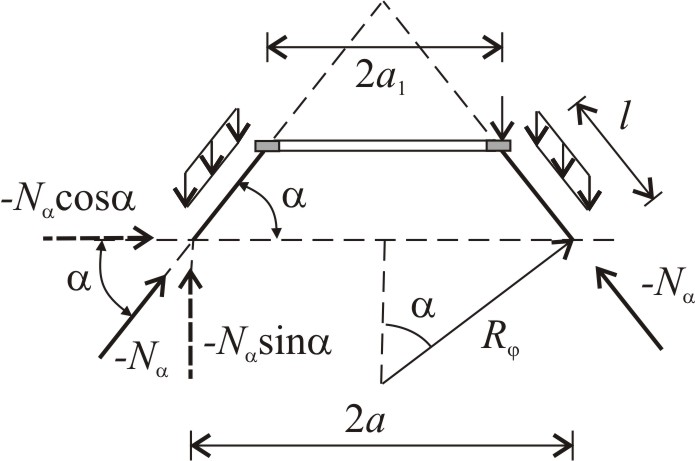

Check resultant of the loadCheck hoop forces
Check diagrams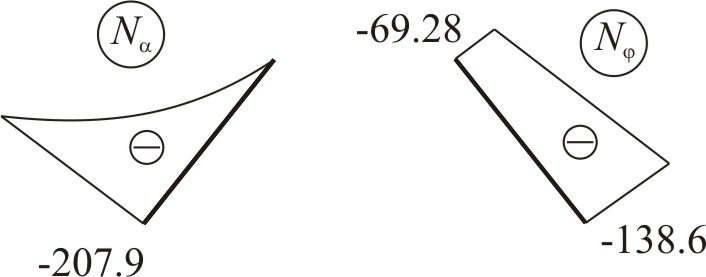
Results
The meridian force of the shell of revolution is expressed from the vertical equilibrium. where G is the resultant of the self-weight of the cone part. The surface of the truncated cone is Thus the resultant of the gravity load is Substituting the load resultant into the vertical equilibrium the meridian force becomes Values of the meridian force at the bottom and at the top are The meridian of a cone is a straight line, hence one of the principal curvatures is zero, the meridian radius of curvature is infinite, Rα = ∞. Thus, the equilibrium perpendicular to the surface simplifies to the “pressure vessel formula”: The normal component of the gravity load referred to the unit area of tangent plane is The hoop radius of curvature, Rφ is: Thus hoop force becomes The membrane force diagrams are given in the Figure below.Worked out solutionThe free body diagram of an arbitrary parallel cut of the cone is given in the Figure below.