
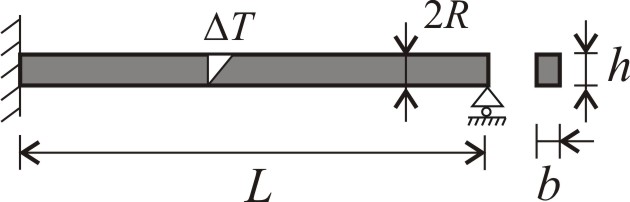
The end of the cantilever given in the previous problem is supported vertically at the endpoint. Determine the reactions arising from linear temperature change. Give the deflection and the bending moment diagram. Geometrical and material data are the same as in the previous problem: ΔT = 50°C, elastic modulus of steel is E = 210 MPa, the (linear) thermal expansion coefficient is α = 1.2×10⁻⁵ 1/°C. The bar has rectangular cross section, b = 30mm, h = 20 mm, length of the bar is L = 600 mm.
Solve Problem
Reaction force of the hinged support, A [kN]= Draw moment and deflection diagrams. Maximum deflection, vmax [mm]=SolveCheck figure
Do you need help?
Steps
Apply the force method. Step 1. Choose a primary structure. The primary structure is chosen to be a cantilever, thus the redundant is the support reaction of the hinge. Step 2. Determine the deflection and moment functions of the primary structure from the temperature load and from the redundant, respectively. From the linearly varying temperature change κ = αΔT/h curvature arise. Bending moment and displacement function from the temperature change are: Bending moment and displacement function from the unit load are: Step 3. Determine redundant from the compatibility condition. Compatibility condition is written at the end of the cantilever, where there is no deflection of the original structure: Step 4. Calculate the support reactions. The support reaction at the hinge is equal to the redundant: The reactions at the built-in support are Step 5. Draw moment and deflection diagrams. Step 6. Calculate the maximum deflection. The deflection function reaches its maximum where the first derivative of the function is zero:Step by step
Show primary structure
Check diagrams
Check redundantCheck reactionsCheck diagrams
Check deflection
Results
We apply the force method. The primary structure is chosen to be a cantilever, thus the redundant is the support reaction of the hinge. The deflection and moment functions of the primary structure from the temperature load and from the redundant are shown in the Figure below. From the linearly varying temperature change κ = αΔT/h curvature arise. Bending moment and displacement function from the temperature change are: Bending moment and displacement function from the unit load are: The redundant is determined from the compatibility condition. Compatibility condition is written at the end of the cantilever, where there is no deflection of the original structure: The support reaction at the hinge is equal to the redundant: The reactions at the built-in support are Moment and deflection functions are:Worked out solution
The deflection function reaches its maximum where the first derivative of the function is zero: