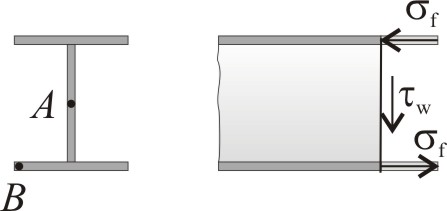
Approximate normal and shear stresses in the cross section of an I-beam are given. Suppose uniform normal stresses in the flanges, and pure shear in the web, the vertical shear stress in the flanges is neglected. .
Determine the principal stresses of point A in the midheight of the web and the maximum shear stress of point B in the tension flange.
Solve Problem
Point A Maximum stress, Minimum stress, [MPa]= Point B Maximum shear stress, Solve
Do you need help?
Steps
Point A Step 1. Write stress vector of point A in x-y coordinate system attached to the beam’s axis. According to the approximation the web is subjected to pure shear stage. The stress vector is Step 2. Determine principal stresses of point A. Step 3. Calculate and draw the principal directions. Principal directions are shown in the Figure. Step 4. Draw the stresses. Pure shear is equivalent to the sum of a pure compression and a pure tension in directions. Point B Step 1. Write stress vector of point B in x-y coordinate system attached to the beam’s axis. According to the approximation the bottom flange is in pure tension stage. The stress vector is . The x and y directions are the principal directions, the principal stress, is equal to the tensile stress, . Step 2. Calculate the maximum shear stress.Step by stepCheck stress vector
Check principal stresses
Check principal directions
Check figure
Check stress vector
Check stress vector
Results
Point A According to the approximation the web is subjected to pure shear stage. The stress vector is The principal stresses of point A are The principal directions are shown in the Figure Pure shear is equivalent to the sum of a pure compression and a pure tension in directions. Point B According to the approximation the bottom flange is in pure tension stage. The stress vector is . The x and y directions are the principal directions, the principal stress, is equal to the tensile stress, . The maximum shear stress isWorked out solution