
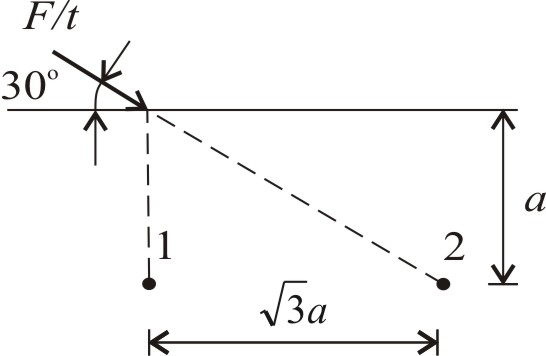
 On the edge of a plate with thickness t, an inclined concentrated force F/t = 600 kN/m acts (see the Figure). Based on the Boussinesq solution calculate the stresses in Points 1 and 2 and give their directions. Locations of the
points are given in the Figure, a = 1.5 m.
Solve Problem
Point 1 Radial stress, Point 2 Radial stress, Solve
Do you need help?
Steps
The distance of Point 1 from the point of application of the load is a. The angle between the axis of the load and the polar coordinate axis, r is 60°. Step 2. Calculate radial stress from the inclined load F at point 2. The distance of Point 2 from the point of application of the load is 2a. The angle between the axis of the load coincide with the polar coordinate axis, r (φ = 0°).Step by stepApply Boussinesq solution. The solution is the same as a vertical force would act on inclined surface.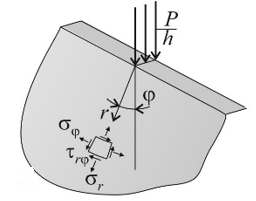

Check stress

Check stress
Results
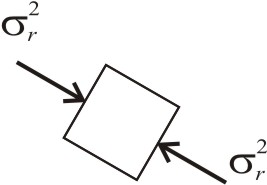
Boussinesq solution is applied. The solution is the same as a vertical force would act on inclined surface. Point 1 The distance of Point 1 from the point of application of the load is a. The angle between the axis of the load and the polar coordinate axis, r is 60°. The radial stress is Point 2 The distance of Point 2 from the point of application of the load is 2a. The angle between the axis of the load coincide with the polar coordinate axis, r (φ = 0°).Worked out solution