
Determine the shear 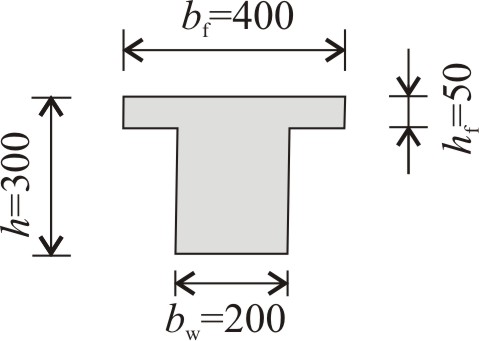 correction factor of a T cross section given in the Figure.
Solve Problem
The shear correction factor is, n =Solve
Do you need help?
Steps
Step 1. Calculate section properties, A, I, yc. Step 2. Determine shear stress distribution the height of the cross section. Shear stress can be determined by the Zhuravskii formula. For the web: Step 3. Sketch shear stress distribution. The shear stress is uniform along the width, the distribution given above is shown in the Figure. Step 4. Integrate the shear stress function and the square of the function over the area of the cross section. Determine the shear correction factor. Shear stiffness is determined using the shear correction factor. The shear correction factor is calculated as: Where we perform the integrations separately over the flange and the web: The shear correction factor results in: The shear stiffness of the cross section is:Step by stepCheck section properties
The function is different in the flange and web of the T section. For simplicity we use different coordinate systems.
 For the flange:
Check shear stress diagram
Check shear correction factor
Results
Shear stress can be determined by the Zhuravskii formula. The moment of area, Sy and the shear stress, τ are expressed parametrically along the height of the cross section. The function is different in the flange and web of the T section. For the web: The shear stress is uniform along the width, the distribution given above is shown in the Figure. Shear stiffness is determined using the shear correction factor. To determine the shear correction factor the shear stress function and the square of the function must be integrated over the area of the cross section. We perform the integrations separately over the flange and the web: The shear correction factor results in: The shear stiffness of the cross section is:Show worked out solutionFirst the properties, A, I, yc are calculated.
For the flange:
undefined