
 The cross section of an I-beam is given in the Figure. The beam is subjected to an axial normal force, P. Give the maximal allowed value of P
a) based on the local buckling of the flange,
b) based on the local buckling of the web.
Assume hinged connection between the web and the flanges in both cases.
Walls are isotropic, their stiffness is: D = 2.4 kNm, ν = 0.3.
Solve Problem
Problem a) Buckling load of the flange, Nx,cr[kN/m]= Problem b) Buckling load of the web, Nx,cr[kN/m]= Critical load of the total cross section, Pcr [kN]=Solve
Do you need help?
Steps
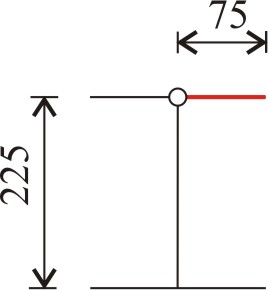
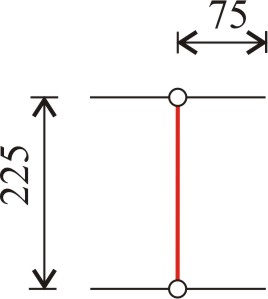
Problem a) Step 1. Determine the buckling load of the flange with one hinged and one free edges. where Ly in the formula is the half width of the flange as it is shown in the Figure. Step 2. Give the value of the load, P acting on the cross section which results the critical load in the flange. Problem b) Step 1. Determine the buckling load of the hinged web. where Ly in the formula is the height of the web as it is shown in the Figure. Step 2. Give the value of the load, P acting on the cross section which results the critical load in the flange. Step 3. Choose the relevant buckling load. Flange loses its stability first, thus flange buckling is relevant.Step by step
Show buckling load of the flange
Show critical loadShow buckling load of the web
Show critical loadShow critical load of the cross section
Results
Problem a) The buckling load of the flange with one hinged and one free edges is where Ly in the formula is the half width of the flange as it is shown in the Figure. The critical load, P acting on the cross section which causes the buckling of the flange is Problem b) The buckling load of the hinged web is where Ly in the formula is the height of the web as it is shown in the Figure. The critical value of the load, P acting on the cross section which cause web buckling is Flange loses its stability first, thus flange buckling results the relevant critical load of the cross section.Worked out solution