
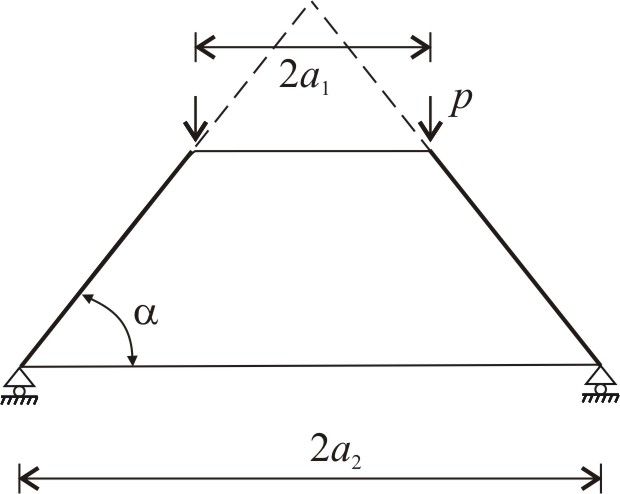
Upper ring of the cone given in Problem 11.17 is removed. (The vertical line load, p = 10 kN/m at the upper edge. The radius of the top edge of the cone is a1 = 10 m, the radius of the bottom edge of the cone is a2 = 20 m, α0 = 60°. Thickness of the shell is h = 10 cm.) Determine the bending moment arising from the vertical edge load.

Solve Problem
Maximum bending moment, Mmax [kNm/m]=Solve
Do you need help?
Steps
Force at the edge has a component in the direction of the meridian force and one which is perpendicular to it, the latter one, p⊥ – which is equal to the shear force at the edge – causes the bending of the shell. Step 2. Calculate the bending moment from the edge disturbance. The moment is approximated by the moment of the osculating cylinder subjected to a line load p⊥: The maximum bending moment occurs at a distance from the support.Step by step
Step 1. Determine the force component which causes the bending of the top edge.Check perpendicular component
Check moment
Results
The maximum bending moment occurs at a distance from the support.Worked out solution
Force at the edge has a component in the direction of the meridian force and one which is perpendicular to it, the latter one, p⊥ – which is equal to the shear force at the edge – causes the bending of the shell.The moment is approximated by the moment of the osculating cylinder subjected to a line load p⊥: