
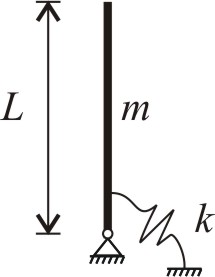
 Derive the eigenfrequency of a rigid bar supported by a rotational spring. The mass per unit length is m, the lenght of the bar is L, the spring has a stiffness, k.
.
Solve Problem
Derive formula of the eigenfrequency, f.SolveCheck formula
Do you need help?
Steps
Step 1. Draw deflected shape during free vibration. Determine the forces acting on the bar. The deflection shape of the rigid bar is linear, it depends on one parameter, the rotation only. The rotation is the function of the time: φ(t). In the spring M = kφ(t) moment arises, while on the rod the fictious D’Alambert forces act according to Newton’s second law: where dots refer to the derivatives with respect to time, t. Step 2. Write the moment equilibrium of the rod about the support. The integration can be performed also by calculating the moment of the resultant of the D’Alambert forces, , the lever arm of which is from the support. Step 3. Assume harmonic motion. Substitute the sinusoidal rotation function into the moment equilibrium equation. Express the eigenfrequency. Step by stepShow figure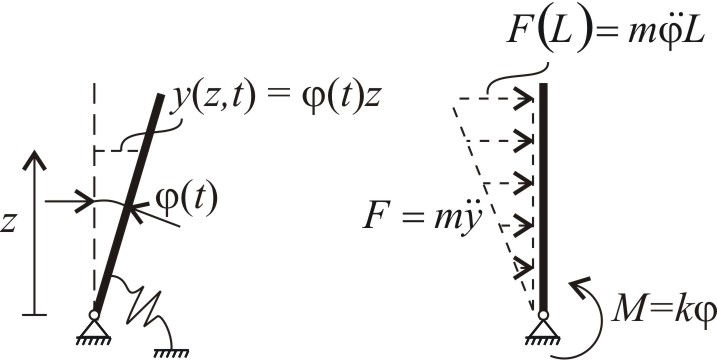

Show moment equilibriumShow eigenfrequency
Results
Deflected shape during free vibration and the forces acting on the bar are given in the figure below. The deflection shape of the rigid bar is linear, it depends on one parameter, the rotation only. The rotation is the function of the time: φ(t). In the spring M = kφ(t) moment arises, while on the rod the fictious D’Alambert forces act according to Newton’s second law: where dots refer to the derivatives according to time, t. Moment equilibrium of the rod is written about the support. The integration can be performed also by calculating the moment of the resultant of the D’Alambert forces, , the lever arm of which is from the support. We assume harmonic motion. The sinusoidal rotation function is substituted into the moment equilibrium equation. The eigenfrequency can be expressed as: Worked out solution