Problem 7.7. Flexural-torsional buckling

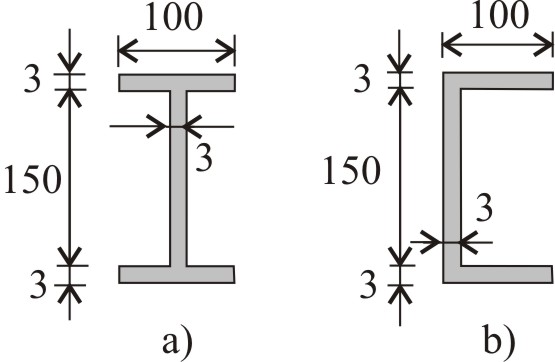
A cantilever is subjected to a concentrated force at the top in the centre of gravity of the cross section. Determine the buckling load(s) for flexural-torsional buckling if the cantilever has

a) I cross section given in Figure a)

b) C cross section given in Figure b)
Length of the cantilever is 1.50 m. Material properties are: E =210 GPa, G = 87.5 GPa.

Solve Problem

Solve

Problem a)

Buckling load in x-y plane, Ny,cr[kN]=

Buckling load in x-z plane, Nz,cr [kN]=

Torsional buckling load, Nω,cr [kN]=

Problem b)

Lowest buckling load, Ncr,1[kN]=

Second lowest buckling load, Ncr,2 [kN]=

Third lowest buckling load, Ncr,3 [kN]=

Do you need help?

Steps
Step by step

Problem a)

Step 1.  Calculate the section properties.

Check section properties

A=2×100×3+150×3=1050 mm2Iy=100×15631297×150312=4.356×106 mm4Iz=21003×312+150×5312=5.003×105 mm4io2=IzA+IyA=5.003×1051050+4.356×1061050=4624.6 mm2

Square of the radius of gyration is given by Equation (7-123)
Iω=bf3tf24d2=1003×3241532=2.926×109 mm6

See Table 3.12.
It=2100×333+150×333=3150 mm4

Step 2.  Determine buckling loads for flexural-torsional buckling.

Check buckling loads

The cross section is doubly symmetrical, thus the buckling loads of the cantilever are

Equation (7-133)
Nz,cr=π2EIy4L2=π2×210×103×4.356×1064×1.5×103=1003.0×103 N=1003.0 kNNy,cr=π2EIz4L2=π2×210×103×5.003×1054×1.5×103=115.2×10³ N=115.2 kNNω,cr=1io2π2EIω4L2+GIt=14624.6π2210×103×2.926×1094×1.5×103+87.5×103×3150=205.3×10³ N=205.3 kN

Problem b)

Step 1.  Calculate the section properties.

Check section properties

A=2×100×3+150×3=1050 mm2Iy=100×15631297×150312=4.356×106 mm4yc=3×100×50×2+150×3×1.5A=29.21 mmIz=23×100312+2×3×100(5029.21)2+150×3312+3×150(29.211.5)2=1.105×106 mm4It=2100×333+150×333=3150 mm4Iω=bf3tfd2123bftf+2dtw6bftf+dtw=1003×3×1532123×100×3+2×153×36×100×3+153×3=4.71×109 mm6e=3bf2tf6bftf+dtw=3×1002×36×100×3+153×3=39.84 mm

See Table 3.12.
io2=IyA+IzA==1.105×1061050+4.356×1061050=5200.7 mm2ysc=yc+e1.5=29.21+39.841.5=67.55 mmipt2=IyA+IzA+ysc2==1.105×1061050+4.356×1061050+67.552=9764.4 mm2

Equations (7-123) and (7-139)

Step 2.  Determine buckling loads for flexural-torsional buckling.

Check buckling loads

The displacement are assumed in the following forms:

vo=AsinπLx, wo=BsinπLx, ψo=CsinπLx

Substituting the displacement functions the governing equations of the beam result in

Equations (7-140)-(7-143)
Ny,crNNz,crNNyscNyscNω,crNipt2ABC=0, whereNz,cr=π2EIy4L2=π2×210×103×4.356×1064×1.5×103=1003.0×103 N=1003.0 kNNy,cr=π2EIz4L2=π2×210×103×1.105×1064×1.5×103=254.5×10³ N=254.5 kNNω,cr=1io2π2EIω4L2+GIt=         =15200.7π2210×103×4.71×1094×1.5×103+87.5×103×3150=261.5×10³ N=261.5 kN

The buckling loads as the eigenvalues of the above matrix result in
Equation (7-146)
Ncr,2=Ny,cr=254.5 kNNcrNz,crNcrNω,cript2Ncr2ysc2=0   Ncr,2, Ncr,3Ncr,1=229.7 kNNcr,3=2144.6 kN

Results
Worked out solution

Problem a)

The section properties are the following

A=2×100×3+150×3=1050 mm2Iy=100×15631297×150312=4.356×106 mm4Iz=21003×312+150×5312=5.003×105 mm4io2=IzA+IyA=5.003×1051050+4.356×1061050=4624.6 mm2

Square of the radius of gyration is given by Equation (7-123)
Iω=bf3tf24d2=1003×3241532=2.926×109 mm6

See Table 3.12.
It=2100×333+150×333=3150 mm4

The cross section is doubly symmetrical, thus the buckling loads of the cantilever are

Equation (7-133)
Nz,cr=π2EIy4L2=π2×210×103×4.356×1064×1.5×103=1003.0×103 N=1003.0 kNNy,cr=π2EIz4L2=π2×210×103×5.003×1054×1.5×103=115.2×10³ N=115.2 kNNω,cr=1io2π2EIω4L2+GIt=14624.6π2210×103×2.926×1094×1.5×103+87.5×103×3150=205.3×10³ N=205.3 kN

Problem b)

The section properties are calculated below:

A=2×100×3+150×3=1050 mm2Iy=100×15631297×150312=4.356×106 mm4yc=3×100×50×2+150×3×1.5A=29.21 mmIz=23×100312+2×3×100(5029.21)2+150×3312+3×150(29.211.5)2=1.105×106 mm4It=2100×333+150×333=3150 mm4Iω=bf3tfd2123bftf+2dtw6bftf+dtw=1003×3×1532123×100×3+2×153×36×100×3+153×3=4.71×109 mm6e=3bf2tf6bftf+dtw=3×1002×36×100×3+153×3=39.84 mm

See Table 3.12.
io2=IyA+IzA==1.105×1061050+4.356×1061050=5200.7 mm2ysc=yc+e1.5=29.21+39.841.5=67.55 mmipt2=IyA+IzA+ysc2==1.105×1061050+4.356×1061050+67.552=9764.4 mm2

Equations (7-123) and (7-139)

The displacement are assumed in the following forms:

vo=AsinπLx, wo=BsinπLx, ψo=CsinπLx

Substituting the displacement functions the governing equations of the beam result in

Equations (7-140)-(7-143)
Ny,crNNz,crNNyscNyscNω,crNipt2ABC=0, whereNz,cr=π2EIy4L2=π2×210×103×4.356×1064×1.5×103=1003.0×103 N=1003.0 kNNy,cr=π2EIz4L2=π2×210×103×1.105×1064×1.5×103=254.5×10³ N=254.5 kNNω,cr=1io2π2EIω4L2+GIt=         =15200.7π2210×103×4.71×1094×1.5×103+87.5×103×3150=261.5×10³ N=261.5 kN

The buckling loads as the eigenvalues of the above matrix result in
Equation (7-146)

Ncr,2=Ny,cr=254.5 kNNcrNz,crNcrNω,cript2Ncr2ysc2=0   Ncr,2, Ncr,3Ncr,1=229.7 kNNcr,3=2144.6 kN