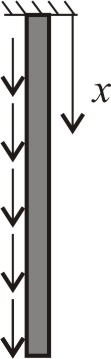
 A steel bar is suspended vertically. The tensile stiffness of the bar is EA, its length is L, density of the material is ρ. Give parametric expression of the total strain from the self-weight. Draw strain and displacement diagrams along the length of the bar.
Solve Problem
Derive the strain function parametrically. Draw strain and displacement diagrams.SolveCheck expressionCheck diagrams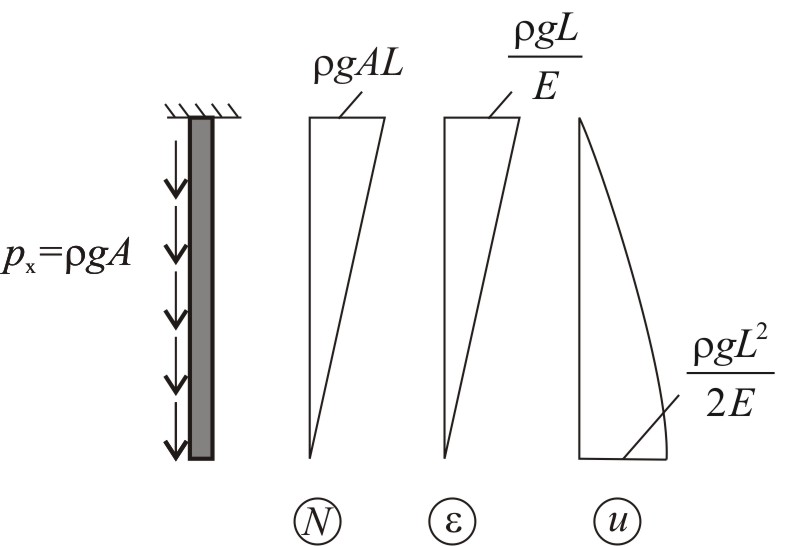
Do you need help?
Steps
Step 1. Give the load and the differential equation of the tensile rod. Step 2. Write the general solution of the homogeneous equation. Step 3. Find a particular solution. where r0 is determined by substituting the particular solution into the differential equation: Step 4. Write the general solution and determine its constants from the boundary conditions. Boundary conditions: At the support the displacement, at the end the normal force is zero. The solution of the differential equation, the displacement function is Step 5. Express the strain function. Draw the strain and displacement diagrams.Step by stepCheck differential equation

Check homogeneous solution
Check particular solution
Check constantsCheck results
Results
The differential equation of the tensile rod subjected to its self-weight is The general solution of the homogeneous equation is A particular solution is where r0 is determined by substituting the particular solution into the differential equation: The constants of the general solution are determined from the boundary conditions. The general solution is The boundary conditions are The solution of the differential equation is the displacement function: Its derivative results in the strain function: The strain and displacement functions are given in the Figure.Worked out solution