
A Timoshenko beam built-in at both ends is subjected to uniformly distributed load. Deflection function is given:
Based on the above deflection give the rotation and the average shear strain functions. Draw the moment and shear force diagrams.
Solve Problem
Give the rotation funcion, Χy and the shear strain, γy. Derive moment and shear force distribution. Draw their diagrams.SolveCheck rotationCheck shear strainCheck internal force diagrams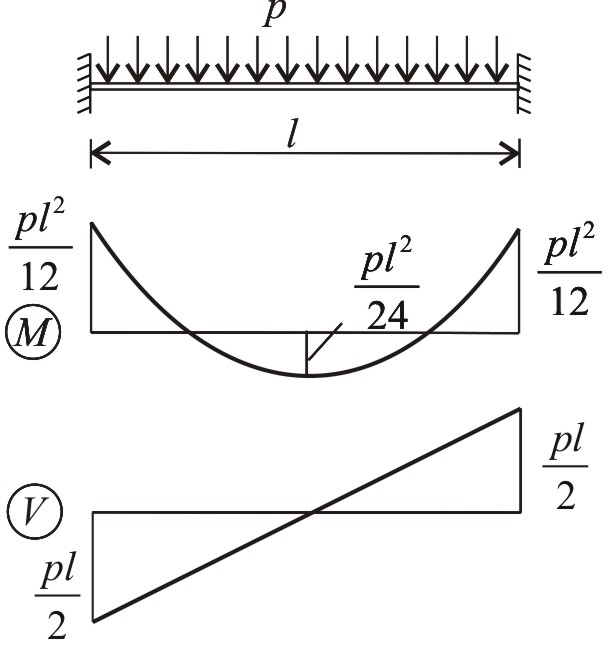
Do you need help?
Steps
Step 1. Separate bending and shear displacements from the given function. The deflection function consists of two parts, the bending and the shear displacements are: Step 2. From bending displacement determine the function of the rotation of the cross section and its derivative. Step 3. From shear displacement give the average shear strain function. Step 4. Determine bending moment distribution from . Step 5. Determine shear force distribution from the shear strain.Step by stepCheck deformations
Check rotationCheck curvatureCheck shear strainCheck moment distribution

Check shear force distribution

Results
The given deflection function consists of two parts, the bending and the shear displacements: The average shear strain function is derived from the shear displacement: We can determine the bending moment distribution from .Show worked out solution
From bending displacement the function of the rotation of the cross section and its derivative can be determined:
The shear force distribution is obtained from the shear strain.
