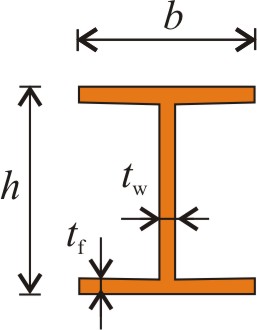
Problem 3.20 Effect of restrained warping

A cantilever I beam (L = 3.0m) is subjected to t = 4 kNm/m uniformly distributed torque load. At the fixed end there is no twist or warping. The thickness of the wall is tw = tf = 12 mm, width of the cross section is b = 260 mm, the height is h = 480 mm. The material properties are E = 210 GPa = 210 ×103 N/mm2, G = 80.8 GPa = 80.8 ×10³ N/mm2. Calculate the rotation at the free end
a) neglecting warping stiffness (EIω = 0),
b) neglecting torsional stiffness (EIt = 0),
c) taking both the warping and torsional stiffness into account.

Solve Problem

Solve

Rotation of the free end, ψ [rad]=

a)

b)

c)

Do you need help?

Steps

Step by step

Problem a)

Step 1. Give the torsional stiffness of the cross section.

Check torsional stiffness

Eq.(3-100)
GIt=Gk=13bktk33=G2btf33+htw33=80.8×1032260×1233+480×1233=4.598×10¹⁰Nmm2

Step 2. Write the differential equation of Saint-Venant torsion.

Check equation

Eq.(3-129), where the warping stiffness is neglected
t=d2ψSVdx2GIt

Step 3. Give the rotation function as the general solution of the differential equation.

Check general solution

ψSV=t2GItx2+C1x+C2

See Example D.5 and Eq.(D-31)

Step 4. Determine constants from boundary conditions.

Check boundary conditions

Boundary conditions are given in Table 3.11.

At the built-in end:

ψSV(0)=0      C2=0

At the free end:

T(L)=dψSVdxGIt=0 dψSVdx=tGItL+C1=0      C1=tLGIt

Step 5. Give the rotation function. Calculate end rotation.

Check end rotation

ψSV=tLGIttx22GItψSV(L)=tL22GIt=4×322×45.98=0.391 rad =22.4

Problem b)

Step 1. Give the warping stiffness of the cross section.

Check warping stiffness

Table 3.12
EIω=Eb3tf24d2=210×1032603×1224480122=4.042×10¹⁷Nmm2

Step 2. Write the differential equation of restrained warping.

Check equation

Eq.(3-129), where the torsional stiffness is neglected
t=d4ψdx4EIω

Step 3. Give the rotation function as the general solution of the differential equation.

Check general solution

ψ=t24EIωx4+C1x36+C2x22+C3x+C4

See Example D.14 and Eq.(D-79)

Step 4. Determine constants from boundary conditions.

Check boundary conditions

Boundary conditions are given in Table 3.11.

At the built-in end:

ψ(0)=0      C4=0ϑ(0)=dψSVdx=0      C3=0

At the free end:

T(L)=d3ψdx3EIω=0   tLEIω  C1=0       C1=tLEIωMω(L)=EIωd2ψdx2=0 tL22EIω +C1L+C2=0      C2=tL22EIω

Step 5. Give the rotation function. Calculate end rotation.

Check end rotation

ψ=tx424EIωtLx36EIω+tL2x24EIωψ(L)=tL424EIωtL46EIω+tL44EIω=tL48EIω=184×34404.2=0.100 rad = 5.74

Problem c)

Step 1. The torsional and warping stiffnesses of the cross section are calculated in Problem a) and b) respectively.

Step 2. Write the differential equation of torsion.

Check equation

Eq.(3-129), where the torsional stiffness is neglected
t=d3ψdx3GIt+d4ψdx4EIω

In the solution follow steps of Example 3.18.

Step 3. Give the solution of the homogeneous equation.

Check homogeneous solution

See Example D.10 and Eq.(D-62)
ψhom=C1+C2x+C3coshμx+C4sinhμx

where

μ=GItEIω

Step 4. Choosing a particular solution give the general solution.

Check particular solution

ψpart=tx22GItψ=ψhom+ψpart=C1+C2x+C3coshμx+C4sinhμxtx22GIt

where

μ=GItEIω

Step 5. Determine constants from boundary conditions.

Check boundary condition

Boundary conditions are given in Table 3.11.

At the built-in end:

ψ(0)=0      C1+C3=0ϑ(0)=dψdx=0      C2+C4μ=0

At the free end:

T(L)=dψdxGItd3ψdx3EIω=0     GIt C2+C3μsinhμL+C4μcoshμLtLEIωC3μ3sinhμL+C4μ3coshμL=0       C2+C3μsinhμLEIωGItμ3sinhμL0+C4μcoshμLEIωGItμ3coshμL0tLGIt=0      C2=tLGItMω(L)=EIωd2ψdx2=0    C3μ2coshμL+C4μ2sinhμLtGIt=0     C3=tGItμ2coshμL1+μLsinhμL      C1=tGItμ2coshμL1+μsinhμL      C4=tLGItμ 

Step 5. Give the rotation function. Calculate end rotation.

Check equation

Substituting the constants the rotation function is obtained:

ψ=tEIωμ21cosh(μL)(1+Lμsinh(μL)cosh(μx)1+Lμ2xμ2x22Lμsinh(μx))

where μ=GItEIω=45.98404.2=0.337

The end rotation is

ψ(L)=tEIωμ2(1cosh(μL)1+Lμsinh(μL)cosh(μL)1+μ2L2Lμsinh(μL))==4404.2×0.3372(1cosh(0.337×3)1+0.337×3sinh(0.337×3)cosh(0.337×3)1+0.3372320.337×3sinh(0.337×3))==0.072 rad = 4.12


Results

Show worked out solution

Problem a)

The torsional stiffness of the thin walled cross section is calculated as

Eq.(3-100)
GIt=Gk=13bktk33=G2btf33+htw33=80.8×1032260×1233+480×1233=4.598×10¹⁰Nmm2

The differential equation of Saint-Venant torsion is

Eq.(3-129), where the warping stiffness is neglected
t=d2ψSVdx2GIt

The rotation function is given as the general solution of the differential equation:

See Example D.5 and Eq.(D-31)

ψSV=t2GItx2+C1x+C2

where the constants are determined from the boundary conditions.

Boundary conditions are given in Table 3.11.

At the built-in end:

ψSV(0)=0      C2=0

At the free end:

T(L)=dψSVdxGIt=0 dψSVdx=tGItL+C1=0      C1=tLGIt

The rotation function and the end rotation are given below.

ψSV=tLGIttx22GItψSV(L)=tL22GIt=4×322×45.98=0.391 rad=22.4

Problem b)

The warping stiffness of the cross section is calculated as

Table 3.12
EIω=Eb3tf24d2=210×1032603×1224480122=4.042×10¹⁷Nmm2

The differential equation of restrained warping is

Eq.(3-129), where the torsional stiffness is neglected
t=d4ψdx4EIω

The rotation function is given as the general solution of the differential equation.

See Example D.14 and Eq.(D-79)

ψ=t24EIωx4+C1x36+C2x22+C3x+C4

The constants are determined from the boundary conditions.

Boundary conditions are given in Table 3.11.

At the built-in end:

ψ(0)=0      C4=0ϑ(0)=dψSVdx=0      C3=0

At the free end:

T(L)=d3ψdx3EIω=0   tLEIω  C1=0       C1=tLEIωMω(L)=EIωd2ψdx2=0 tL22EIω +C1L+C2=0      C2=tL22EIω

The rotation function and the calculated end rotation are given below

ψ=tx424EIωtLx36EIω+tL2x24EIωψ(L)=tL424EIωtL46EIω+tL44EIω=tL48EIω=184×34404.2=0.100 rad=5.74

Problem c)

The torsional and warping stiffnesses of the cross section are calculated in Problem a) and b) respectively.

The differential equation of torsion is

Eq.(3-129), where the torsional stiffness is neglected
t=d3ψdx3GIt+d4ψdx4EIω

In the solution follow steps of Example 3.18.
First the solution of the homogeneous equation is derived.

See Example D.10 and Eq. (D-62)
ψhom=C1+C2x+C3coshμx+C4sinhμx

where

μ=GItEIω

Then a particular solution is chosen. The general solution is shown below.

ψpart=tx22GItψ=ψhom+ψpart=C1+C2x+C3coshμx+C4sinhμxtx22GIt

The constants are determined from the boundary conditions.

Boundary conditions are given in Table 3.11.

At the built-in end:

ψ(0)=0      C1+C3=0ϑ(0)=dψdx=0      C2+C4μ=0

At the free end:

T(L)=dψdxGItd3ψdx3EIω=0     GIt C2+C3μsinhμL+C4μcoshμLtLEIωC3μ3sinhμL+C4μ3coshμL=0       C2+C3μsinhμLEIωGItμ3sinhμL0+C4μcoshμLEIωGItμ3coshμL0tLGIt=0      C2=tLGItMω(L)=EIωd2ψdx2=0    C3μ2coshμL+C4μ2sinhμLtGIt=0     C3=tGItμ2coshμL1+μLsinhμL      C1=tGItμ2coshμL1+μsinhμL      C4=tLGItμ 

Substituting the constants the rotation function is obtained:

ψ=tEIωμ21cosh(μL)(1+Lμsinh(μL)cosh(μx)1+Lμ2xμ2x22Lμsinh(μx))

where μ=GItEIω=45.98404.2=0.337

The end rotation isψ(L)=tEIωμ2(1cosh(μL)1+Lμsinh(μL)cosh(μL)1+μ2L2Lμsinh(μL))==4404.2×0.3372(1cosh(0.337×3)1+0.337×3sinh(0.337×3)cosh(0.337×3)1+0.3372320.337×3sinh(0.337×3))==0.072 rad = 4.12