
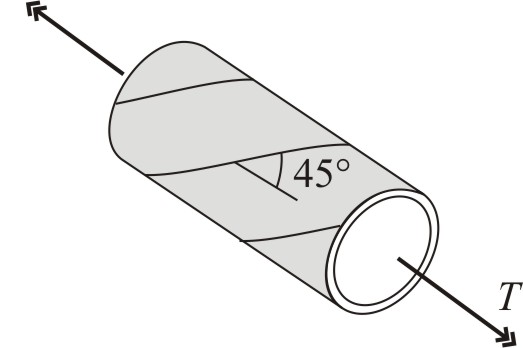
A concentrated torque, T acts on the welded tube. The tube was manufactured by the welding of a plate with 6 mm thickness, its outer diameter is 100 mm. Angle of the weld is 45° (see the Figure). Give the maximum allowable value of the torque based on the resistance of the weld. Strength of the welding material is 80 MPa. Use Rankine failure criterion.
Note that in weld design usually the normal stress in the longitudinal direction of the weld is not taken into account. (In this example, as will be shown, there is a compression stress in the longitudinal direction, which is equal to the tensile stress perpendicular to the welding.)
Solve Problem
Maximum allowed torque, Tallowed [kNm] =Solve
Do you need help?
Steps
Step 1. Calculate the torsional stiffness of the tube cross section. Step 2. Write the maximum shear stress in the function of the unknown torque. Step 3. Perform stress transformation into a coordinate system attached to the weld’s direction. Step 4. Express allowed torque from Rankine criterion. No shear arises in the rotated coordinate system, the axis are in the principal directions. Rankine criterion yields Assuming thin walled cross section the maximum allowed torque is: Assuming thick walled cross section the maximum allowed torque is: Results are close two each other, thus both approximations are appropriate.Step by stepCheck torsional stiffness assuming thin walls
Check torsional stiffness assuming thick wallsCheck shear stress
Check stress transformationThe rotation angle is 45°. Shear results in tension and compression in 45° degree direction.
Check allowed torque
Results
The torsional stiffness of the tube cross section can be calculated assuming thin walled or thick walled cross section. Both calculations will be presented. Assuming thin walled beam: Assuming thick walls: The maximum shear stress can be given in the function of the unknown torque: Now stress transformation is performed into a coordinate system attached to the weld’s direction. The rotation angle is 45°. Shear results in tension and compression in 45° degree direction. No shear arises in the rotated coordinate system, the axis are in the principal directions. Rankine criterion yields Assuming thin walled cross section the maximum allowed torque is: Assuming thick walled cross section the maximum allowed torque is: Results are close two each other, thus both approximations are appropriate.Show worked out solution