
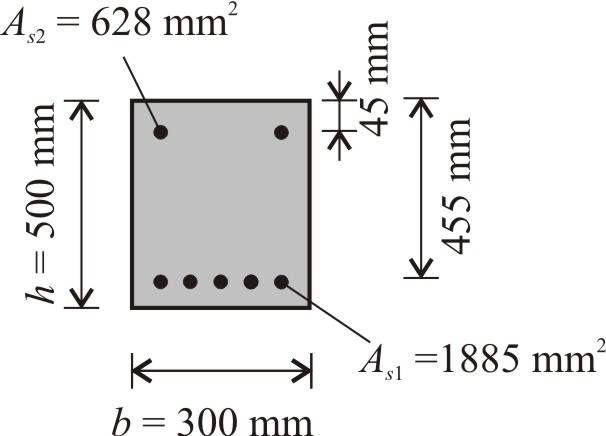
The reinforced concrete cross section given in the figure is subjected to pure bending. Does the cross section crack for a moment, M = 32 kNm? Determine the stresses in the extreme concrete fibres and in the steel. Give the curvature which belongs to the moment, M. σ(ε) diagrams of steel and concrete are the same as given in Problem 4.4 (see also the attached Figure). (In case of cracked section neglect the tensile stress in concrete.)

Solve Problem
Cracking moment Mcr [kNm]= Stress in extreme concrete fiber, σc [N/mm2]= Stress in tensile steel, σs1 [N/mm2]= Stress in compressed steel, σs2 [N/mm2]= Curvature, Solve
Do you need help?
Steps
Concrete is chosen to be the reference material. Ratio of elastic moduli of concrete and steel is denoted by The cross sectional properties of the replacement homogeneous cross section are Step 2. Calculate the cracking moment. Concrete cracks when stress in the bottom extreme fiber reaches the tensile strength of concrete. Thus the concrete cracks. Step 3. Calculate the section properties of the cracked cross section. After cracking of the cross section the tensile stress in the concrete is neglected, both the steel and the compressed concrete zone still behave in a linearly elastic manner. Compressed concrete zone and tensile steel bars are replaced again by an equivalent homogeneous cross section. From the concrete cross section only the compressed concrete zone is taken into consideration (xcb), where xc is unknown (see Figure below). The cross sectional properties of the equivalent homogeneous cross section are Step 4. Determine the relevant stress values in the concrete and in the steel bars. We assume that the concrete, the tensile and also the compressed steel bars are in elastic stage. Relevant stress values are in the top extreme concrete fibre: in the tensile steel bars: in the compressed steel bars: Stresses arising in the cross section are lower than the tensile and compressive strength of the materials, thus the materials of the cross section behave in a linearly elastic manner. Step 5. Give the curvature from the given moment. Compare result to that of Problem 4.4. Tensile stiffness increase stiffness and reduce displacements.Step by step
Step 1. Calculate the section properties of the inhomogeneous cross section in elastic stage.
Check uncracked section properties

Check cracking moment
Check cracked section properties
Check stresses
Check curvature
Results
Concrete is chosen to be the reference material. Ratio of elastic moduli of concrete and steel is denoted by The cross sectional properties of the replacement homogeneous cross section are Concrete cracks when stress in the bottom extreme fiber reaches the tensile strength of concrete. The cracking moment is Thus the concrete cracks. After cracking of the cross section the tensile stress in the concrete is neglected, both the steel and the compressed concrete zone still behave in a linearly elastic manner. Compressed concrete zone and tensile steel bars are replaced again by an equivalent homogeneous cross section. From the concrete cross section only the compressed concrete zone is taken into consideration (xcb), where xc is unknown (see Figure below). The cross sectional properties of the equivalent homogeneous cross section are We assume that the concrete, the tensile and also the compressed steel bars are in elastic stage. Relevant stress values are in the top extreme concrete fibre: in the tensile steel bars: in the compressed steel bars: Stresses arising in the cross section are lower than the tensile and compressive strength of the materials, thus the materials of the cross section behave in a linearly elastic manner. The curvature from the given moment is Compare result to that of Problem 4.4. Tensile stiffness increase stiffness and reduce displacements.Worked out solution
First elastic materials and uncracked cross section is assumed. The inhomogeneous cross section is replaced by an equivalent homogeneous one.