
A one way slab, modelled as a beam with length L = 7.5 m, bending stiffness EI = 30×106 Nm2/m and uniformly distributed mass m = 1200kg/m2 is subjected to a uniformly distributed harmonic load: . The damping ratio is ξ = 2 %.
Determine the maximum acceleration and displacement from the steady-state solution using the modal analysis with the ABSSUM rule
a) The excited frequency is f = 2.5 Hz.
b) Assume that the excited frequency may vary between 2 and 3 Hz.
Solve Problem
Problem a) Maximum displacement for f = 2.4 Hz, vdyn [mm]= Maximum acceleration for f = 2.4 Hz, adyn [m/s2]= Problem b) Maximum displacement for f = 3 Hz, vdyn [mm]= Maximum acceleration for f = 3 Hz, adyn [m/s2]=Solve
Do you need help?
Steps
Step 1. Give the first five eigen modes of a one way slab (beam). Step 2. Replace the load by the eigen mode series expansion. The eigenmode series expansion of the load – since the eigenmodes are sinusoidal – is identical to its Fourier series expansion. The first five terms are: Step 3. Calculate the static displacements due to the sinusoidal loads. Step 4. Determine the eigenfrequencies. The response is determined for the three nonzero terms. The eigenfrequencies are: Problem a) Step 5. Give the corresponding β-s and the dynamic amplification factors for f = 2.4 Hz. Step 6. Calculate the maximum dynamic displacement and the maximum acceleration. The maximum dynamic displacement can be calculated as: The maximum acceleration is We may observe that the first term dominates and the contribution of the higher terms is less then 0.5%. Problem b) Step 5. Give the corresponding β-s and the dynamic amplification factors for f = 3 Hz. When the excited frequency is closer to the eigenfrequency the responses are higher. For f = 3 Hz the β-s and the dynamic amplification factors are: Step 6. Calculate the maximum dynamic displacement and the maximum acceleration. The maximum dynamic displacement can be calculated as: The maximum acceleration isStep by stepCheck eigen modes 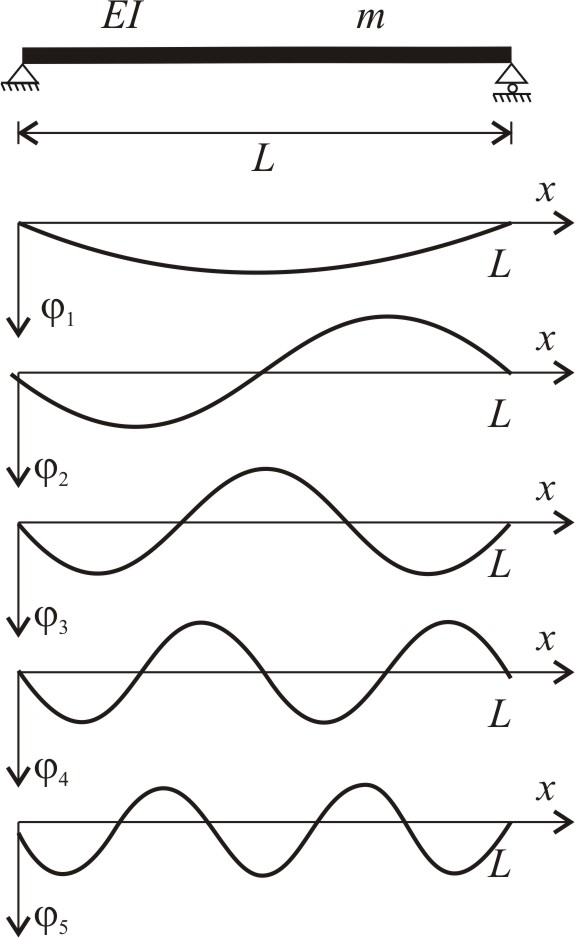

Check eigen mode expanison of the load
Check static displacements
Check eigenfrequencies
i
1
3
5
βi
0.5662
0.06291
0.02265
Dδi
1.471
1.004
1.001
Di
0.4716
0.00397
0.000513
i
1
3
5
βi
0.6794
0.07549
0.02718
Dδi
1.855
1.006
1.001
Di
0.8564
0.00573
0.000739
Results
The first five eigen modes of a one way slab (beam) are shown in the Figure. The load is replaced by the eigenmode series expansion, which – since the eigenmodes are sinusoidal – is identical to its Fourier series expansion. The first five terms are: The static displacements due to the three sinusoidal loads are: Now the response is determined for the three nonzero terms. The eigenfrequencies are: Problem a) The corresponding β-s and the dynamic amplification factors for f = 2.4 Hz are: The maximum acceleration is We may observe that the first term dominates and the contribution of the higher terms is less then 0.5%. Problem b) When the excited frequency is closer to the eigenfrequency the responses are higher. For f = 3 Hz the β-s and the dynamic amplification factors are: The maximum dynamic displacement can be calculated as: The maximum acceleration isWorked out solution
i
1
3
5
βi
0.5662
0.06291
0.02265
Dδi
1.471
1.004
1.001
Di
0.4716
0.00397
0.000513
The maximum dynamic displacement can be calculated as:
i
1
3
5
βi
0.6794
0.07549
0.02718
Dδi
1.855
1.006
1.001
Di
0.8564
0.00573
0.000739