
A cylindrical shell is subjected to a radial uniform load, p = 10 kN/m2. The cylinder has a radius R = 3 m and a height H = 12 m. Thickness of the wall is h = 20 cm. Both edges are fixed. Determine the maximum bending moment in the wall. Calculate the maximum hoop force.
Solve Problem
Maximum bending moment, Mmax [kNm/m]= Maximum hoop force, [kN/m]=Solve
Do you need help?
Steps
The membrane solution is independent of the axial coordinate: Step 2. Determine the bending moment from the compatibility at the boundaries. Use the analogy of beams resting on elastic foundation. The compatibility is ensured by the solution of a strip of plate on elastic foundation. where D is the bending stiffness, and The maximum bending moment arises at the support. It can be approximated as Step 3. Give the maximum hoop force. The hoop force can be calculated from the displacements: To find the maximum of the hoop force first derivative of Nφ is determined: The hoop force reaches its maximum where the above derivative is zero: The maximum hoop force is Step 4. Draw the internal force diagrams. Step by step
Step 1. Give the membrane solution for uniform pressure.Check membrane solution
Check bending moment
Check maximum hoop force
Check diagrams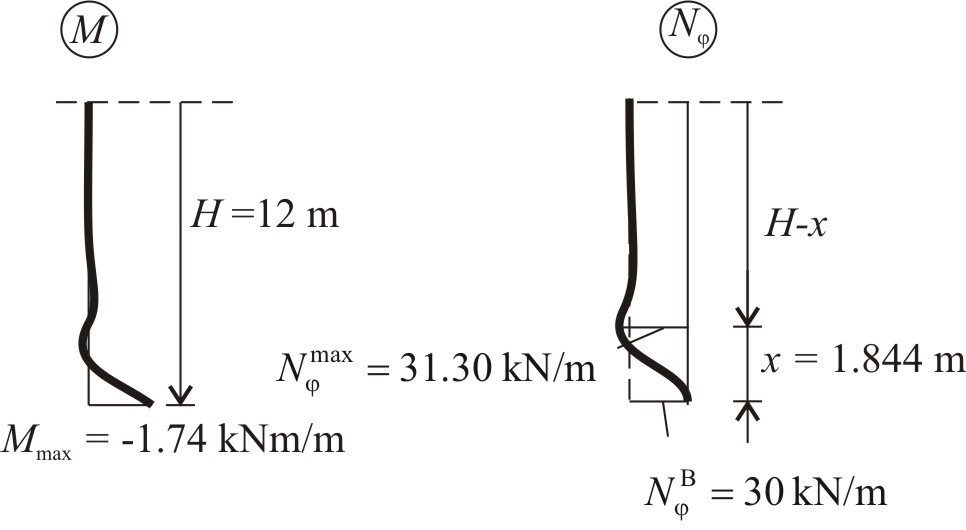
Results
Using the analogy of beams resting on elastic foundation the compatibility of the boundary is ensured. The moment becomes: where D is the bending stiffness, and Note that the origin of the coordinate system is at the top of the cylinder. The maximum bending moment arises at the support. It can be approximated as The hoop force can be calculated from the displacements: To find the maximum of the hoop force first derivative of Nφ is determined: The hoop force reaches its maximum where the above derivative is zero: The maximum hoop force is The internal force diagrams are shown in the Figure.Worked out solution
First the membrane solution of the cylinder is determined.The membrane solution for uniform pressure is independent of the axial coordinate: