
Take into consideration the beam’s mass, mb = 125 kg/m in the previous problem. Determine the modified eigenfrequency of the slab.
a) Approximate using the deflections of the beam and the slab.

b) Use Dunkerley’s approximation.
Stiffness of the simply supported beams are: EI = 6.42×10⁵ kNm2. Stiffness of the isotropic plate is: Ds = 9.3 × 10 Nm2/m, mass of the plate is m = 540 kg/m2.
Solve Problem
Problem a) Approximate eigenfrequency calculated from the deflecions, fn [Hz]= Problem b) Approximate eigenfrequency calculated by the summation theorems, fn [Hz]=Solve
Do you need help?
Steps
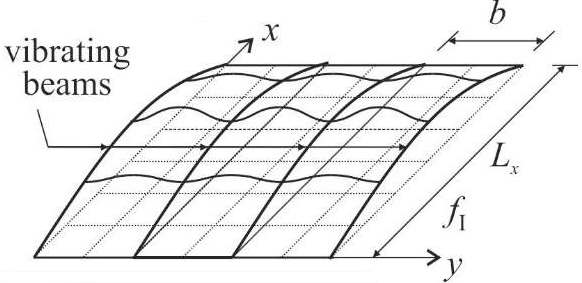
Problem a) Step 1. Determine the deflections of the beam and the slab. The beam’s deflection is modified by the beam’s weight. The multispan slab is assumed to be a 1 m wide single span beam built-in at both ends. Step 2. Approximate the eigenfrequency of the slab with the superposition of the above deflections. Problem b) Step 1. Approximate eigenfrequency of the beam using Dunkerley’s theorem. Approximate eigenfrequency of the hinged beam with two masses is Step 2. Determine the eigenfrequency of the whole plate using Föppl’s approximation. Eigenfrequency of the hinged slab: In the relevant vibration mode both the beams and the plate undergo vibration as it is shown in the Figure. The eigenfrequency is approximated by Föppl’s theorem. The edges of the slab is assumed to be built-in as the deformed shape shows.Step by step
Show deflectionsShow eigenfrequency
Show eigenfrequency
Show eigenfrequency
Results
Problem a) The beam’s deflection is modified by the beam’s weight. The multispan slab is assumed to be a 1 m wide single span beam built-in at both ends. Approximate eigenfrequency of the slab is given using the superposition of the above deflections. Problem b) Approximate eigenfrequency of the hinged beam with two masses is Eigenfrequency of the hinged slab: In the relevant vibration mode both the beams and the plate undergo vibration as it is shown in the Figure. The eigenfrequency is approximated by Föppl’s theorem. The edges of the slab is assumed to be built-in as the deformed shape shows.Worked out solution