
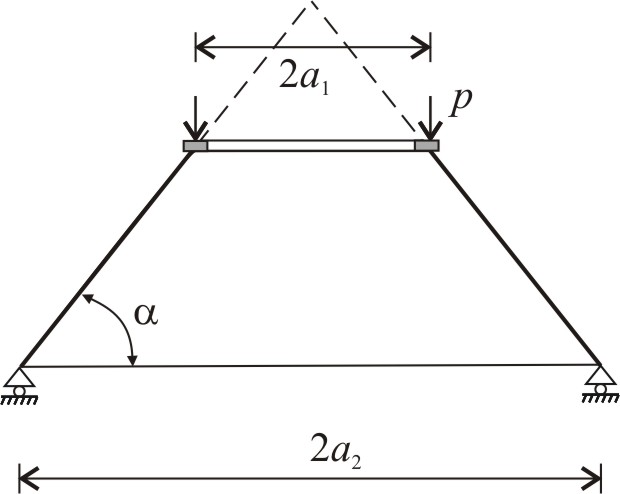
Assume that the cone shown in the Figure is supported vertically only at the bottom. The truncated cone is subjected to a vertical line load, p = 10 kN/m at the upper edge. The radius of the top edge of the cone is a1 = 10 m, the radius of the bottom edge of the cone is a2 = 20 m, α0 = 60°. Thickness of the shell is h = 10 cm. Determine the bending moment.

Solve Problem
Maximum bending moment, Mmax [kNm/m]=Solve
Do you need help?
Steps
Step 1. Calculate the vertical reaction force. The vertical support force, A is calculated from the vertical equilibrium: Step 2. Determine the force component which causes the bending of the edge. A has a component in the direction of the meridian force and one which is perpendicular to it, the latter one, A⊥ – which is equal to the shear force at the edge – causes the bending of the shell. Step 3. Calculate the bending moment from the edge disturbance. The moment is approximated by the moment of the osculating cylinder subjected to a line load, A⊥: The maximum bending moment occurs at a distance from the bottom of the cone.Step by step
Check vertical reaction
Check perpendicular component
Check moment
Results
The vertical support force, A is calculated from the vertical equilibrium: A has a component in the direction of the meridian force and one which is perpendicular to it, the latter one, A⊥ – which is equal to the shear force at the edge – causes the bending of the shell. The moment is approximated by the moment of the osculating cylinder subjected to a line load, A⊥: The maximum bending moment occurs at a distance from the bottom of the cone.Worked out solution