
 Determine the eigenfrequency of the water tower given in Problem 7.5. (Neglect the motion of the water relative to the container.) Which summation theorem(s) must be applied in the approximation? The water tower of height H = 40 m is supported elastically by a circular foundation. The top weight is G = 10 × 103 kN, while the distributed weight of the shaft is g = 250 kN/m. The shaft’s bending stiffness is EI = 1 × 10⁹ kNm2, the stiffness of the foundation is k = 300 × 106 kNm.
Solve Problem
Eigenfrequency, f [Hz]=Solve
Do you need help?
Steps
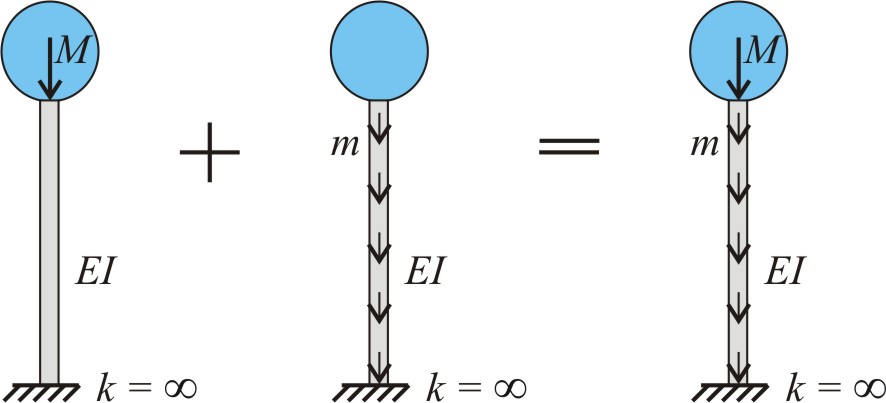
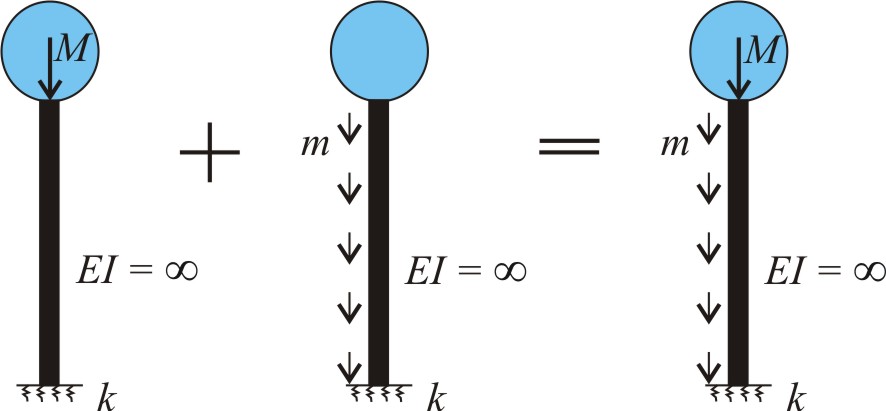
Step 1. Assume rigid foundation. Approximate natural frequency of the cantilever with uniform and concentrated masses. The natural frequency of a cantilever with uniform mass is The natural frequency of a cantilever with top concentrated mass is where k is determined as the force-deflection ratio of the cantilever subjected to a concentrated top force. Apply Dunkerley’s approximation to take into consideration both of the masses. Step 2. Assume elastic foundation. Approximate natural frequency of the cantilever with uniform and concentrated masses. The natural frequency of a beam supported by a spring with uniform mass is derived in Problem 8.6: The natural frequency of the beam with top concentrated mass is Apply Dunkerley’s approximation to consider both masses. Step 3. Apply Föppl’s approximation to take both supports into account.Step by step
Show frequency, f1
Show frequency, f2
Show frequency, f 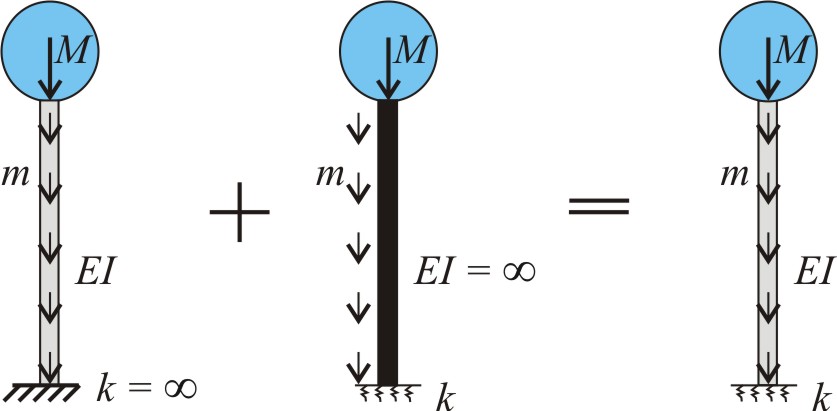
Results
First rigid foundation is assumed. The natural frequency of a cantilever with uniform mass is The natural frequency of a cantilever with top concentrated mass is where k is determined as the force-deflection ratio of the cantilever subjected to a concentrated top force. Now Dunkerley’s approximation is applied to take into consideration both of the masses. Second elastic foundation is assumed. The natural frequency of a beam supported by a spring with uniform mass is is derived in Problem 8.6: The natural frequency of the beam with top concentrated mass is Dunkerley’s formula approximatites the effect of both masses. Finally Föppl’s approximation is applyied to take both supports into account.Worked out solution